
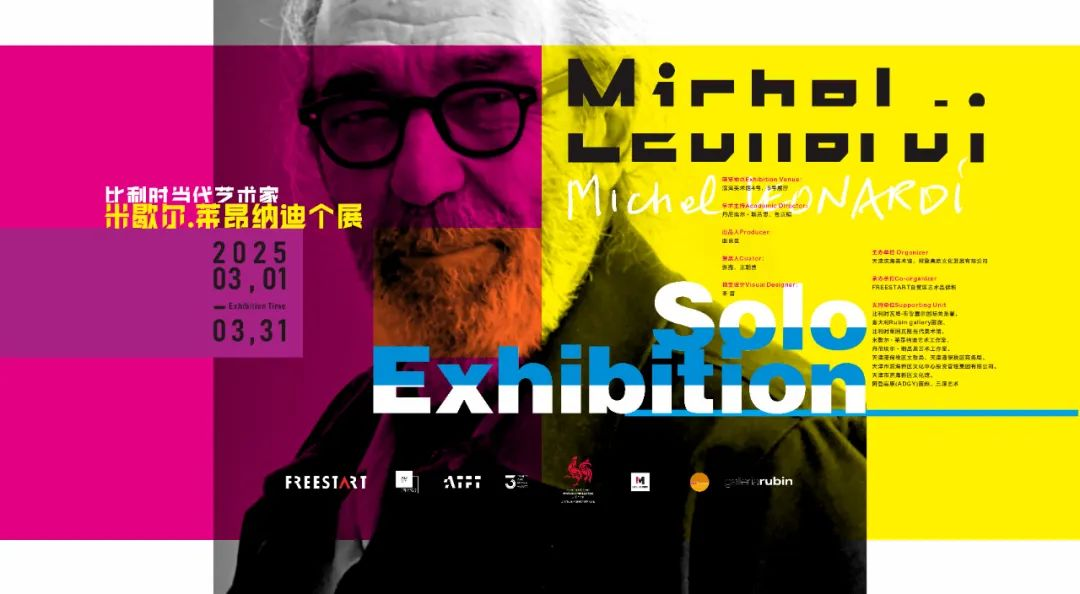
Precision and Purity — The Painting Practice of Michel Leonardi
In 2024, Michel Leonardi—one of Belgium’s most significant contemporary painters—debuted his first Chinese solo exhibition at the Luxun Academy of Fine Arts Museum in Shenyang. Coinciding with his residency at the Shenyang FTZ International Bonded Art Service Center, the 70-year-old artist created large-scale new works, embodying his enduring passion for Sino-Belgian cultural exchange.
The Conceptual Core: Rejecting the "Society of the Spectacle"
Leonardi’s practice is radically conceptual, prioritizing color and formal minimalism over political/social narratives. Using traditional oil painting, he rebels against Guy Debord’s "society of the spectacle"—the tyranny of mass images over daily life. As Duchamp urged, "Art belongs to life," Leonardi seeks inner clarity through painting, stripping away decorative illusions.
His works reject chiaroscuro, texture, and representational time. Instead, color ellipsoids—laboriously layered on flat canvases—act as temporal capsules, neither mimicking the external world nor pandering to viewer expectations. This radical reduction aims to "rewire visual perception", forcing audiences into estrangement—a rupture from media-saturated minds to raw chromatic experience.
Form as Liberation: The Elliptical "Tag"
Leonardi’s signature elliptical schema is a deliberate choice—a "non-confrontational, soft, almost figurative egg shape" that paradoxically anchors his "figurative yet abstract" vision. Unlike artists who flaunt technical complexity (David Salle’s critique of "over-presentation"), Leonardi chooses minimalist candor, allowing the act of painting itself to dominate.
His studio labor—repetitive, meditative "gestural smearing"—becomes the unspoken hero of his practice. By omitting this process from exhibitions, he subverts the "vanity" of art consumption, urging viewers to engage not with spectacle but with the discipline behind the form.
Color Beyond Ideology
While historical colors carry heavy symbolism (e.g., imperial yellow, revolutionary red), Leonardi’s palette is intuitive yet intentional. He seeks to "reimagine the aesthetic pact between nature and the cosmos", divorcing color from narrative or symbolism. Each canvas is a self-contained chromatic vortex, transcending cultural and ideological boundaries—a universal shockwave of pure hue.
In his exhibitions, audiences escape media bombardment, submerged in Leonardi’s mathematically calibrated hues. The gallery becomes a sanctuary where "visual infinity is unearthed through disciplined constraint"—liberated by color’s unapologetic simplicity.
Legacy and Process
Leonardi’s genius lies not in what he includes, but what he abolishes: only color, form, and the ritual of painting remain. His "tag" is not a style but a vow—an endless cycle of "painterly devotion" that reaffirms easel painting’s relevance in a digital age. As Bao Guitao concludes:
"He doesn’t paint—he stamps time with color."
By Bao Guitao (Curator/Art Critic)